Layers
Four nn.Module layers cover the usual patterns, and they can all be used inside
nn.Sequential. Most of these layers expose in_features and out_features.
MinMaxNorm uses feature_dim.
The three layers that build a circuit, Basic, Reupload and
Ensemble, take the same provider= argument as Circuit, and they pass it to the
circuit unchanged.
MinMaxNorm is classical arithmetic and has no circuit to run, so it does not take
the argument, and passing it raises a TypeError.
The same three layers return the provider on .provider, as the resolved backend,
whichever form was passed in. .provider.name is its registered name:
from eigenkit import Basic, PennyLaneConfig

layer = Basic(n_qubits=4, depth=2, provider=PennyLaneConfig())
layer.provider.name  # "pennylane"
| Layer | Pattern |
|---|---|
Basic |
One encoding, one variational block, and a measurement of each qubit. |
Reupload |
Standard data reuploading, optionally with a trainable scale. |
Ensemble |
N independent circuits, one for each chunk of the input. |
MinMaxNorm |
Min/max normalisation of each feature, in the style of batch normalisation. |
Basic
Basic is the thinnest wrapper around Circuit: one encoding, one variational
block, and a measurement of each qubit. Use it for textbook variational classifiers
and regressors, where n_features == n_qubits.
import torch
from eigenkit import Basic

# Defaults: RX encoding, RY variational, Z basis, which are three different axes.
layer = Basic(n_qubits=4, depth=2)
out = layer(torch.randn(8, 4))  # shape (8, 4)
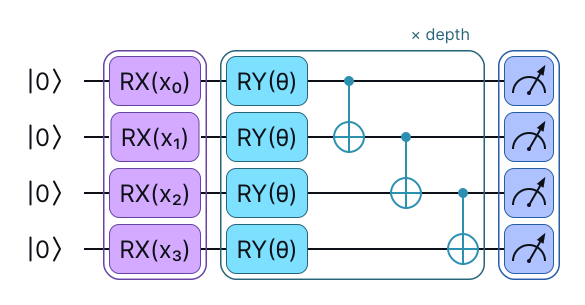
The circuit that this call builds. RX(x_i) encodes one feature per qubit. Then the
basic variational block, which is one RY(θ) per qubit followed by the ladder of
controlled-NOT (CNOT) gates, repeats depth times, and every qubit is measured in
Z. These three axes are the defaults. With variational_type="strong", each
RY(θ) box becomes the three rotations RZ, RY and RZ.
Some combinations of axes make the circuit inert
Some choices of enc_rotation, var_rotation and basis build a circuit whose
weights, or whose input, provably cannot reach the output. All three layers check
for this and issue a UserWarning that names the reason. The layer is still
built, because you may want to build a degenerate circuit on purpose, as a
baseline.
There are three ways to get one:
- The weights commute with the observable. With
variational_type="basic"andvar_rotationon the measurement axis (RZwithbasis="Z", orRXwithbasis="X"), the rotations and the CNOT ladder both preserve that group of Pauli operators. The weights then cancel out of the expectation value, and every gradient is exactly0. Rotate away from the measurement axis, or usevariational_type="strong", whose three rotationsRZ,RYandRZalways include one away from the axis. RZencoding. The circuit starts in|0...0⟩, which everyRZleaves unchanged up to a phase, so the input never enters.Reuploadescapes this once it encodes again, because the second encoding acts on a state that has already moved.BasicandEnsembleencode only once, so they do not escape it.- A real circuit measured in
Y.RYand CNOT are real matrices, so anRYencoding withRYrotations keeps the statevector real, and⟨Y⟩is always0on a real state.
Sharing an axis is not a problem in itself. RY rotations with basis="Y" train
well on two qubits or more, because the CNOT ladder does not preserve strings of
Y operators.
Reupload
Reupload is standard data reuploading in a single circuit. The input is encoded
again depth times, with new variational weights between the encodings. Set
trainable_scale=True to add a trainable scale for each pair of layer and feature
(Schuld et al. 2021).
Here, in_features == n_qubits.
from eigenkit import Reupload

# Encoding on RX, variational on RY: same rule as Basic.
layer = Reupload(n_qubits=4, depth=3, enc_rotation="RX", trainable_scale=True)
out = layer(torch.randn(8, 4))  # shape (8, 4)
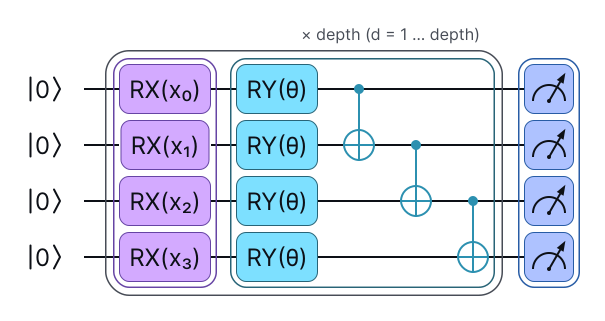
What distinguishes this layer from Basic is where the outer bracket starts. It
covers the encoding as well as the variational block, so the input is encoded again
at each repetition, with new weights. The circuit is drawn with enc_rotation="RX",
as in the call above, and without the trainable scale. With trainable_scale=True,
each RX(x_i) becomes RX(λ·x_i), with one trainable λ for each pair of layer and
feature.
Keep enc_rotation and var_rotation on different axes here too. When they share
one, each R(x) and the R(θ) that follows it combine into a single R(x + θ), and
the variational weights of that layer become a plain offset of the data angle. The
defaults of Reupload put both rotations on RY, so pass enc_rotation
explicitly, as in the call above.
Ensemble
Ensemble runs N independent circuits, one for each chunk of the input, each with
its own weights. The outputs are concatenated along the feature dimension.
from eigenkit import Ensemble

layer = Ensemble(in_features=20, n_qubits=4, depth=5)
out = layer(torch.randn(128, 20))  # shape (128, 20): 5 circuits * 4 qubits
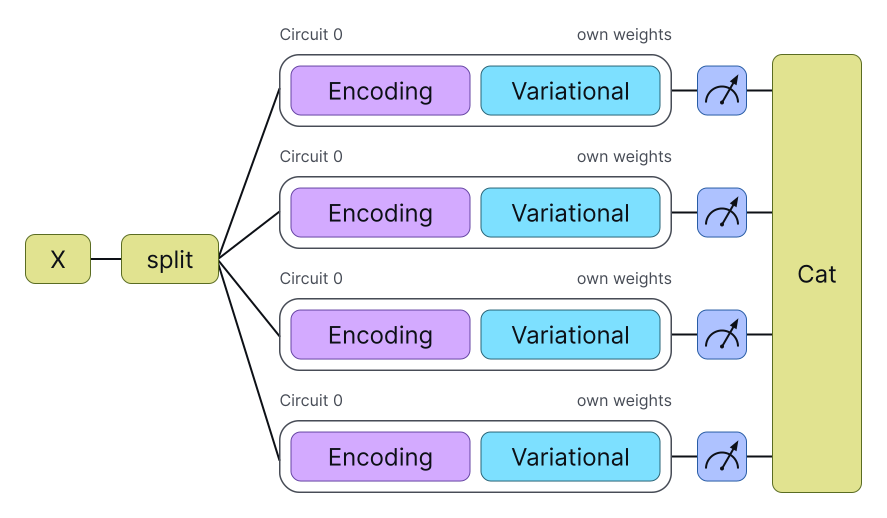
The input is split into chunks of n_qubits features, and each chunk gets its own
circuit, with its own weights and its own measurement. The outputs of the circuits
are concatenated back into one feature vector. Nothing is shared between the
branches: no statevector and no parameters. Four branches are drawn, while the call
above has five. Note also that on this layer, the variational block defaults to
variational_type="strong", not "basic".
MinMaxNorm
MinMaxNorm normalises each feature with its minimum and maximum, and keeps running
statistics. It is useful before encoding rotations, which expect bounded angles.
import torch
from eigenkit import MinMaxNorm

norm = MinMaxNorm(feature_dim=16, min_val=0.0, max_val=torch.pi)
In training mode, it uses the minimum and maximum of each batch, and it updates an
exponential moving average of them (momentum=0.1 by default). In evaluation mode, it
uses the running statistics. The output is clamped to [min_val, max_val], to guard
against outliers that were not seen in training.
API reference
eigenkit.torch.layers
Quantum layers for the standard patterns.
Basic: oneEncoding, oneVariationalblock and a measurement.Reupload: standard data reuploading, optionally with a trainable scale.Ensemble:Nindependent circuits, one for each chunk of the input.MinMaxNorm: min-max normalisation of each feature, in the style ofBatchNorm.
Basic
Bases: Module
One Encoding, one Variational block and a measurement on each qubit.
Parameters:
| Name | Type | Description | Default |
|---|---|---|---|
n_qubits
|
int
|
The number of qubits, which is also the number of input features. |
required |
depth
|
int
|
The number of variational layers. |
required |
enc_rotation
|
Literal['RX', 'RY', 'RZ']
|
The encoding rotation: |
'RX'
|
var_rotation
|
Literal['RX', 'RY', 'RZ']
|
The variational rotation. It is used only when
|
'RY'
|
variational_type
|
Literal['basic', 'strong']
|
|
'basic'
|
basis
|
Literal['X', 'Y', 'Z']
|
The Pauli measurement basis: |
'Z'
|
provider
|
ProviderSpec
|
The backend that runs the circuit. Default: |
'numpy'
|
Example
provider
property
The backend that the circuit of this layer was compiled for.
The constructor takes provider= in the same forms as Circuit (a
registered name, a configuration or a backend object) and turns it into
one Provider. This property returns it. The registered name is
provider.name.
Returns:
| Name | Type | Description |
|---|---|---|
provider |
Provider
|
The backend that the circuit runs on. |
forward(x)
Run the layer.
Parameters:
| Name | Type | Description | Default |
|---|---|---|---|
x
|
Tensor
|
The input batch, of shape |
required |
Returns:
| Name | Type | Description |
|---|---|---|
out |
Tensor
|
The output of the layer for that batch. |
Ensemble
Bases: Module
An ensemble of independent quantum circuits, one for each chunk of the input.
Parameters:
| Name | Type | Description | Default |
|---|---|---|---|
in_features
|
int
|
The total number of input features. It must be a multiple of
|
required |
n_qubits
|
int
|
The number of qubits of each circuit. |
required |
depth
|
int
|
The number of variational layers of each circuit. |
required |
enc_rotation
|
Literal['RX', 'RY', 'RZ']
|
The encoding rotation: |
'RX'
|
var_rotation
|
Literal['RX', 'RY', 'RZ']
|
The variational rotation. It is used only when
|
'RY'
|
variational_type
|
Literal['basic', 'strong']
|
|
'strong'
|
basis
|
Literal['X', 'Y', 'Z']
|
The Pauli measurement basis: |
'Z'
|
provider
|
ProviderSpec
|
The backend that runs the circuits. Default: |
'numpy'
|
Example
provider
property
The backend that the circuits of this layer were compiled for.
The constructor takes provider= in the same forms as Circuit (a
registered name, a configuration or a backend object) and turns it into
one Provider. This property returns it. The registered name is
provider.name.
Returns:
| Name | Type | Description |
|---|---|---|
provider |
Provider
|
The backend that the circuits run on. |
forward(x)
Run the layer.
Parameters:
| Name | Type | Description | Default |
|---|---|---|---|
x
|
Tensor
|
The input batch, of shape |
required |
Returns:
| Name | Type | Description |
|---|---|---|
out |
Tensor
|
The output of the layer for that batch. |
MinMaxNorm
Bases: Module
Min-max normalisation of each feature, with running statistics.
It rescales each feature to [min_val, max_val]. In training mode, it uses
the minimum and maximum of each batch, and it updates an exponential moving
average of these statistics. In evaluation mode, it uses the running
statistics. A training batch of a single row has no range, so it uses the
running statistics too, and if no batch with a range has been seen yet, it
returns the row unchanged with a warning. Training and evaluation modes work
as in the BatchNorm and LayerNorm layers of PyTorch, but the output is
rescaled to a fixed interval instead of standardised.
It is useful to prepare the inputs of quantum encoding rotations, which
expect angles in a bounded range such as [0, π].
Parameters:
| Name | Type | Description | Default |
|---|---|---|---|
feature_dim
|
int
|
The number of features in the last dimension of the input.
The inputs have shape |
required |
min_val
|
float
|
The lower bound of the target interval. Default: |
0.0
|
max_val
|
float
|
The upper bound of the target interval. Default: |
pi
|
momentum
|
float
|
The momentum factor of the exponential moving average of the
running statistics. Default: |
0.1
|
Example
forward(x)
Run the layer.
Parameters:
| Name | Type | Description | Default |
|---|---|---|---|
x
|
Tensor
|
The input batch, of shape |
required |
Returns:
| Name | Type | Description |
|---|---|---|
out |
Tensor
|
The output of the layer for that batch. |
Reupload
Bases: Module
The data-reuploading layer (Perez-Salinas 2020; Schuld 2021).
It supports two patterns:
- Standard reuploading (the default). The same input is encoded
depthtimes, with new variational weights between the encodings. - Trainable feature scaling (
trainable_scale=True). Each encoding rotation becomesR(lambda * x), with a trainablelambdafor each pair of layer and feature.
Parameters:
| Name | Type | Description | Default |
|---|---|---|---|
n_qubits
|
int
|
The number of qubits, which is also the number of input features. |
required |
depth
|
int
|
The number of times the input is encoded. |
required |
enc_rotation
|
Literal['RX', 'RY', 'RZ']
|
The encoding rotation: |
'RY'
|
var_rotation
|
Literal['RX', 'RY', 'RZ']
|
The variational rotation. It is used only when
|
'RY'
|
variational_type
|
Literal['basic', 'strong']
|
|
'basic'
|
basis
|
Literal['X', 'Y', 'Z']
|
The Pauli measurement basis: |
'Z'
|
trainable_scale
|
bool
|
If True, each encoding rotation gets a trainable scale
for each pair of layer and feature. The CUDA Quantum backend does not
support it, because its |
False
|
provider
|
ProviderSpec
|
The backend that runs the circuit. Default: |
'numpy'
|
Example
provider
property
The backend that the circuit of this layer was compiled for.
The constructor takes provider= in the same forms as Circuit (a
registered name, a configuration or a backend object) and turns it into
one Provider. This property returns it. The registered name is
provider.name.
Returns:
| Name | Type | Description |
|---|---|---|
provider |
Provider
|
The backend that the circuit runs on. |
forward(x)
Run the layer.
Parameters:
| Name | Type | Description | Default |
|---|---|---|---|
x
|
Tensor
|
The input batch, of shape |
required |
Returns:
| Name | Type | Description |
|---|---|---|
out |
Tensor
|
The output of the layer for that batch. |